Table of contents
Quick answer
The terms worth knowing before you book: a broker arranges your shipment, a carrier drives the truck, dispatch is the moment a carrier accepts your car, the pickup window is the date range you agreed, the Bill of Lading is the inspection record you sign twice, and COD is the balance you pay the driver at delivery. Everything else on this page is detail you can look up when it appears.
The companies and people
| Term | What it means |
|---|---|
| Broker | Arranges your shipment with a licensed carrier for a fee. Most companies you find online are brokers. |
| Carrier | Owns the truck and moves the car. May be one truck or a fleet. |
| Dispatcher | The person who matches loads to trucks and books your car onto one. |
| Marketplace | A platform where carriers bid for your shipment instead of a company quoting you. |
| Owner-operator | A carrier that is one driver with one truck. |
| Shipper | You, in industry language: the person handing over the car. |
| Consignee | Whoever receives the car at the other end. |
Broker
- What it means
- Arranges your shipment with a licensed carrier for a fee. Most companies you find online are brokers.
Carrier
- What it means
- Owns the truck and moves the car. May be one truck or a fleet.
Dispatcher
- What it means
- The person who matches loads to trucks and books your car onto one.
Marketplace
- What it means
- A platform where carriers bid for your shipment instead of a company quoting you.
Owner-operator
- What it means
- A carrier that is one driver with one truck.
Shipper
- What it means
- You, in industry language: the person handing over the car.
Consignee
- What it means
- Whoever receives the car at the other end.
The paperwork
| Term | What it means |
|---|---|
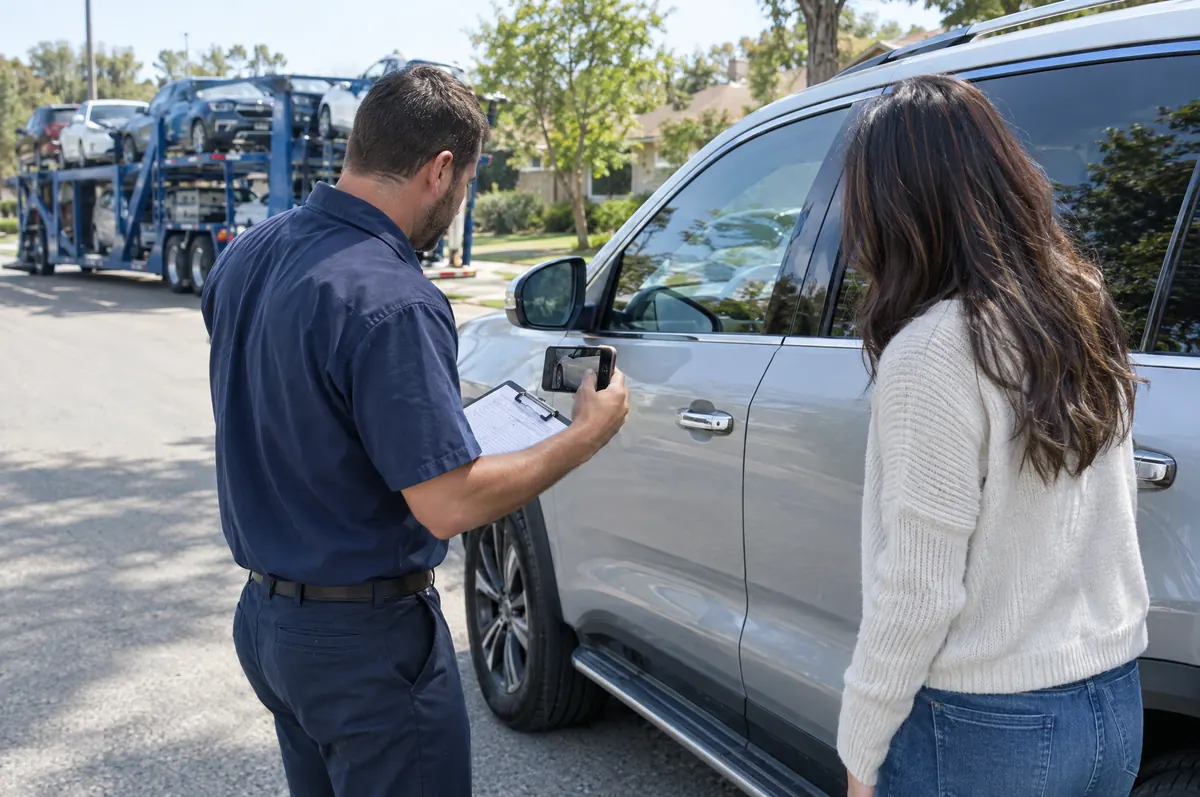
| Bill of Lading (BOL) | The receipt and inspection record. You sign it at pickup and again at delivery; it decides who pays for damage. |
| Condition report | The damage diagram on the Bill of Lading, marked up during the walk-around. |
| Order confirmation | The booking document listing route, dates, price and terms. Not the same as dispatch. |
| Certificate of insurance (COI) | The carrier's proof of coverage, issued by its insurer. Ask for the cargo section. |
| USDOT number | The federal registration number for a carrier or broker. Public, and worth looking up. |
| MC number | The older operating-authority number, still used alongside USDOT. |
| BMC-84 bond | The $75,000 surety bond (or BMC-85 trust) a broker must hold. |
Bill of Lading (BOL)
- What it means
- The receipt and inspection record. You sign it at pickup and again at delivery; it decides who pays for damage.
Condition report
- What it means
- The damage diagram on the Bill of Lading, marked up during the walk-around.
Order confirmation
- What it means
- The booking document listing route, dates, price and terms. Not the same as dispatch.
Certificate of insurance (COI)
- What it means
- The carrier's proof of coverage, issued by its insurer. Ask for the cargo section.
USDOT number
- What it means
- The federal registration number for a carrier or broker. Public, and worth looking up.
MC number
- What it means
- The older operating-authority number, still used alongside USDOT.
BMC-84 bond
- What it means
- The $75,000 surety bond (or BMC-85 trust) a broker must hold.
Sources: 49 CFR 373.101, 49 CFR 387.307
The money words
| Term | What it means |
|---|---|
| Deposit | The part you pay up front, usually the broker's fee. Check what happens to it if nothing is dispatched. |
| COD | Cash on delivery: the balance you hand the driver when the car arrives. Ask which payment methods the driver takes. |
| Carrier pay | What the carrier is paid for the job. It is not your price: the broker's fee sits on top. |
| All-in price | A quote that includes the broker fee and the carrier pay in one number. |
| Guaranteed price | A price the company commits to. Read what voids it. |
| Expedited fee | Extra paid to get a car collected inside a tighter window. |
Deposit
- What it means
- The part you pay up front, usually the broker's fee. Check what happens to it if nothing is dispatched.
COD
- What it means
- Cash on delivery: the balance you hand the driver when the car arrives. Ask which payment methods the driver takes.
Carrier pay
- What it means
- What the carrier is paid for the job. It is not your price: the broker's fee sits on top.
All-in price
- What it means
- A quote that includes the broker fee and the carrier pay in one number.
Guaranteed price
- What it means
- A price the company commits to. Read what voids it.
Expedited fee
- What it means
- Extra paid to get a car collected inside a tighter window.
Timing, trucks and routes
| Term | What it means |
|---|---|
| Pickup window | The date range in which a carrier will collect the car, not a single appointment. |
| Dispatch | The moment a specific carrier accepts your car. Before dispatch you have a booking, not a truck. |
| Transit time | Days on the road once the car is collected, set by distance and driving limits. |
| Door-to-door | The truck comes as close to your address as it legally and safely can. |
| Terminal-to-terminal | You drop off and collect at a yard, which can be cheaper and less flexible. |
| Snowbird season | The autumn and spring waves of cars moving south and north, when capacity tightens. |
| Deadhead | Miles a truck runs empty. Carriers price to avoid them, which is why some routes cost more. |
| Top load | A spot on the upper deck, away from drips from the car above. |
| Winch service | Loading a car that can't be driven with a winch, booked as inoperable transport. |
Pickup window
- What it means
- The date range in which a carrier will collect the car, not a single appointment.
Dispatch
- What it means
- The moment a specific carrier accepts your car. Before dispatch you have a booking, not a truck.
Transit time
- What it means
- Days on the road once the car is collected, set by distance and driving limits.
Door-to-door
- What it means
- The truck comes as close to your address as it legally and safely can.
Terminal-to-terminal
- What it means
- You drop off and collect at a yard, which can be cheaper and less flexible.
Snowbird season
- What it means
- The autumn and spring waves of cars moving south and north, when capacity tightens.
Deadhead
- What it means
- Miles a truck runs empty. Carriers price to avoid them, which is why some routes cost more.
Top load
- What it means
- A spot on the upper deck, away from drips from the car above.
Winch service
- What it means
- Loading a car that can't be driven with a winch, booked as inoperable transport.
Terms you'll meet less often
- Driveaway: someone drives your car to the destination instead of trucking it, adding mileage.
- Tow-away: the car is towed on its own wheels behind a truck, on a tow bar or saddle-mount.
- Hotshot: a smaller trailer pulled by a heavy-duty pickup, often one to three cars.
- Load board: the marketplace where brokers post loads and carriers pick them up.
- RoRo: roll-on/roll-off ocean shipping, where the car is driven onto the vessel.
- Container shipping: the car is secured inside an ocean container, usually for high-value or overseas moves.
- Lienholder letter: your lender's written permission to ship a financed car, sometimes required.
Frequently asked questions
What does COD mean in car shipping?
Cash on delivery: the balance you pay when the car arrives, usually to the driver. Ask in advance which payment methods that driver accepts, because some take only cash, a certified check or a money order.
What is dispatch, and why does it matter?
Dispatch is the moment a named carrier accepts your car onto a specific truck. Until then you have a booking and a price, not a collection. When you ask a company for a status update, the useful question is whether your car has been dispatched.
What is a Bill of Lading?
It is the carrier's receipt for your car and the record of its condition. You and the driver inspect the car and sign at pickup, then again at delivery. Federal rules set out what the receipt must show, and it is the first document a claim turns on.
Am I talking to a broker or a carrier?
Ask directly, then check the USDOT number. Brokers arrange transport for a fee and hold $75,000 in financial security; carriers own the trucks. Both are legitimate, and most online quotes come from brokers.
Why is pickup a window and not a time?
A truck is collecting several cars along a route, and traffic, weather and driving-hour limits move the schedule. Companies quote a range because a single promised hour would usually be wrong.
Is a top-load spot worth paying for?
It keeps your car away from any drips from the vehicle above and off the lowest ramp angles. Owners of low or freshly painted cars ask for it; for an everyday car it is optional.
Sources
Written and reviewed by the Haulwide editorial team. Editorial policy