Table of contents
Quick answer
Do it in this order: find out who legally owns the car now, get the title transferred or an affidavit accepted, insure it before it moves, then arrange transport. Most states have a route that avoids probate for a vehicle, with a value cap and a specific form, and it is usually much faster than waiting for an estate to close. The car does not need to run, and it does not need to be registered in your name before a carrier will move it — but you do need to be able to show you are entitled to it.
Before anything else: who owns it now?
A vehicle does not transfer to you because you were named in a will or because you are the next of kin. Until the paperwork says otherwise it belongs to the estate, and that is the thing that has to be resolved first. Everything else waits on it.
- If the title already names a beneficiary, some states let it pass directly on death with a death certificate. Check the title itself before assuming probate is needed.
- If there is a surviving joint owner, how the names were joined on the title decides whether it passes automatically. "Or" and "and" mean different things here.
- If the estate is small, most states have an affidavit route that skips probate entirely.
- If none of those apply, the executor transfers it as part of settling the estate, on the estate's timetable rather than yours.
The gap nobody mentions: insuring a car nobody is driving
A policy does not simply continue after the policyholder dies. Cover can lapse, and a car sitting on a driveway during a hard month is exposed to exactly the things that happen to unattended cars.
- Call the insurer early and say what has happened. Ask plainly whether the vehicle is still covered and for how long.
- Ask what cover exists while the car is parked and unused, which is not the same as being driven.
- Sort out cover before the car moves, not on the day. A carrier's cargo insurance covers the car in transit, not what happened to it beforehand.
If the car has been standing a while
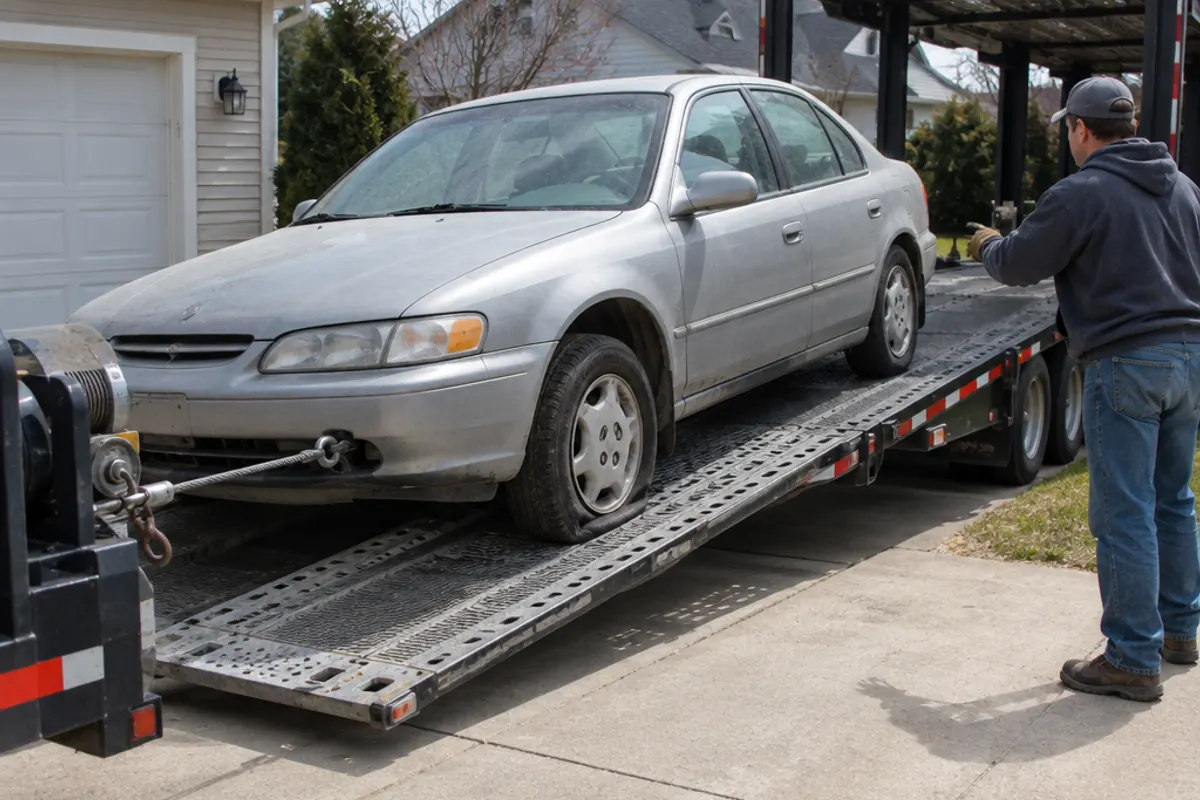
Inherited cars have often not moved in months. That changes what you are booking, because a vehicle that will not start is a different job with a different price, and finding out at pickup is the expensive way to learn it.
- Find out whether it runs, rolls, brakes and steersThose four are what a carrier actually needs to know. A car that rolls and steers can be winched; one that will not is a specialist job.
- Say so when you bookBooking a running car and presenting one that does not is the most common cause of a driver refusing a pickup and a re-booking fee.
- Check the tires hold airFlat tires on a car that otherwise rolls are a small problem that becomes a large one on a loading ramp.
- Find the keysIt sounds obvious. It is also the single most common thing missing when a car is collected from an estate.
If it does not run
Moving it, and what a carrier will ask
A transport company does not verify ownership, and it is not their job to. What they need is someone who can release the vehicle at one end and receive it at the other, and a clear account of the car's condition.
- Someone has to be present at collection to sign the condition report. If you cannot be there, name someone who can and tell the company in advance.
- The pickup address is often a home that is being cleared or sold. Confirm access will still exist on the day, because dates slip.
- Photograph the car thoroughly before it is collected. With an inherited vehicle you may not know what damage was already there, and the condition report is the only record that matters afterwards.
- If the car is going straight to a buyer rather than to you, say so when booking. Delivering to a third party is ordinary, but it has to be arranged rather than sprung on the driver.
Whether to move it at all
This is worth asking honestly and early, because the arithmetic often points one way while the feeling points the other, and both are legitimate.
Moving a car a long distance costs what it costs regardless of what the car is worth. For a vehicle of modest value, the transport can be a meaningful fraction of what it would sell for locally, and selling where it stands is the simpler course. For a car that is worth keeping, or worth keeping for reasons that have nothing to do with money, the cost is the cost and that is a perfectly good answer.
Work out the numbers
The order, in one list
- Find the title and read itIt may already name a beneficiary or a joint owner, which changes everything that follows.
- Call the DMV in the state that issued itAsk what they need for a deceased owner and whether an affidavit route applies.
- Sort the insuranceBefore the car moves, and ideally before it sits for another week.
- Establish whether it runsRuns, rolls, brakes, steers. Those four answers set the price.
- Decide whether to move it or sell it thereWith the transport quote and the local value side by side.
- Book, and name who will hand it overSomeone has to sign the condition report at the collection end.
- Register it where you liveOnce it arrives, with its own deadline in your state.
After it arrives
Frequently asked questions
Can I ship a car before the title is in my name?
Usually yes. A transport company needs someone who can release the vehicle and someone who can receive it, not proof of ownership. What the title does govern is whether you can register, sell or legally drive the car afterwards, which is why the paperwork is worth starting first even though it does not block the move.
Do I have to wait for probate?
Often not. Most states have an affidavit route for a vehicle that avoids probate where the estate or the car is under a value cap — California's applies to estates of $150,000 or less, New York's to one vehicle worth up to $25,000 for a surviving spouse or a child under 21. The form and the cap differ by state, so ask the agency that issued the title.
Is the car still insured after the owner dies?
Do not assume so. A policy does not automatically continue, and cover can lapse while the car sits. Call the insurer, say what has happened and ask directly what is covered and until when. Sort it before the car moves.
What if it has not been driven in months?
Say so when you book. A carrier needs to know whether the car runs, rolls, brakes and steers, and a non-running vehicle is a different job at a different price. Presenting a car that will not move after booking it as one that does is the usual cause of a refused pickup.
Shipping a non-running carIs it worth shipping a car I inherited?
Compare the transport cost against what the car would fetch where it stands. Long-distance transport costs the same whether the car is worth $3,000 or $30,000, so for a modest vehicle selling locally is often simpler. For a car worth keeping, financially or otherwise, that is a fine answer too.
Sources
- California DMV, estate valued at $150,000 or less
- USAGov: State motor vehicle services
- FMCSA: Protect your move
Written and reviewed by the Haulwide editorial team. Editorial policy